What Is MIT Technology Review's AI Hype Index?
The MIT Technology Review AI Hype Index is an editorial series — not a quantitative score — that tracks the cultural and commercial momentum of AI roughly every two to three months. MIT Technology Review describes it as a "highly subjective take on the latest buzz about AI," weighing genuine technical progress against marketing noise and rendering a verdict on net momentum . Because the format holds contradictions rather than resolving them, a single edition can simultaneously report rising and falling signals — which is exactly what the May 2026 installment does.
Quick Answer: The MIT Technology Review AI Hype Index is a recurring editorial series (not a scored index) tracking AI's cultural and commercial momentum. The May 2026 edition found AI booed at graduation ceremonies while funded at record scale — a contradictory reading backed by GoTo data showing 46% of Gen Z workers believe AI degrades their cognitive capabilities.
The series has run at least six times since April 2025 , with each edition using a different cultural or industry flashpoint as its primary lens. Its editorial method tracks both boosting signals (investment, adoption, capability claims) and deflating signals (public skepticism, visible failures, regulatory friction) simultaneously, then renders a verdict on net hype direction. This is not a methodology you can replicate with a spreadsheet — it is explicitly a qualitative editorial judgment, which makes it useful precisely because it captures how a well-informed observer actually reads the cultural temperature around AI rather than averaging survey responses.
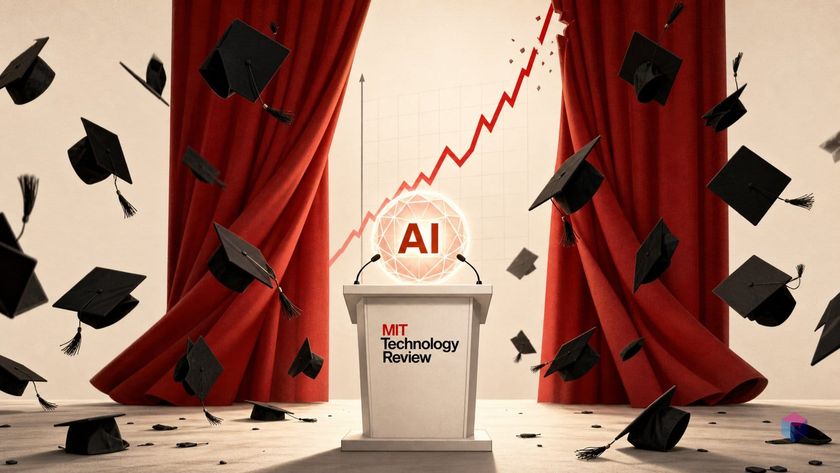
The May 2026 edition, published May 28 , uses commencement ceremonies as a cultural proxy for how the workforce-entering cohort perceives AI versus how the industry presents it. Graduation speeches are one of the few remaining mass-audience moments where an industry's cultural standing gets tested without algorithmic mediation. When students boo an AI pitch at a ceremony, the signal is synchronous, witnessed, and unfiltered. Prior editions established the baseline — including the "great hype correction" of December 2025 — making the May 2026 contradiction reading legible against a progression, not a single data point.
| Month | Edition Topic | Primary Lens | Editorial Verdict |
|---|---|---|---|
| April 2025 | AI Agent Cyberattacks | Security risk from autonomous AI agents | Mixed / Cautionary |
| June 2025 | AI Toys | Consumer AI gadgets and companion devices | Skeptical |
| September 2025 | Chatbot Adoption | Enterprise and consumer chatbot uptake | Cautiously up |
| December 2025 | The Great Hype Correction | Recalibration after overpromised timelines | Down |
| March 2026 | AI in Military Contexts | Defense AI adoption and autonomous weapons | Rising with friction |
| May 2026 | AI Gets Booed in Graduation Season | Commencement backlash as Gen Z barometer | Maximum internal contradiction |
The Commencement Backlash: Who Got Booed and Why
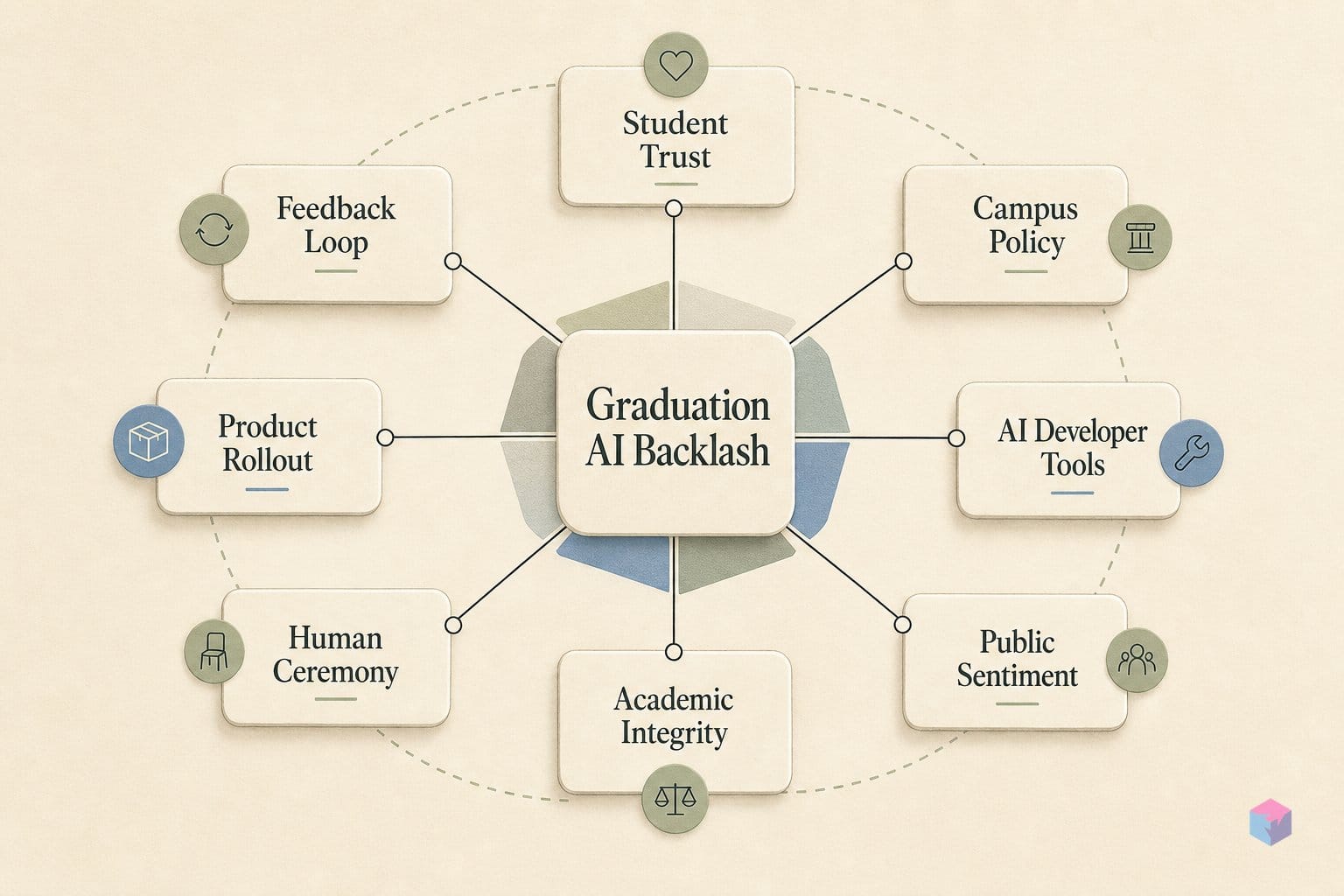
At least four separate US commencement ceremonies in May 2026 saw students audibly boo speakers who praised AI, according to reporting from HuffPost and Government Technology . The incidents share a consistent pattern: backlash peaked when speakers treated AI adoption as settled and dismissed job displacement concerns, and moderated measurably when speakers acknowledged real tradeoffs. For developers thinking about how AI products get received by the people who actually operate them day-to-day, the pattern is worth reading closely.
The first incident occurred at the University of Central Florida's College of Arts and Humanities on May 8, 2026 . Gloria Caulfield, VP of Strategic Alliances at Tavistock Development Company, described AI as "the next industrial revolution," drawing immediate boos. The ceremony paused; Caulfield reportedly asked "What happened?" Graduate Ethan Lubin explained the reaction: discussing AI at an arts and humanities college "goes against the humanities part." The critique is not anti-technology in the abstract — it is about context. Framing AI as inevitably positive inside an institution built on human expression landed as a category error, not a technological objection.
Three days later at Middle Tennessee State University on May 9, 2026, Scott Borchetta, CEO of Big Machine Records, told music industry graduates that "AI is rewriting production as we sit here" . Students booed. His response:
"Deal with it. Like I said, it's a tool." — Scott Borchetta, CEO at Big Machine Records, responding to student boos at MTSU commencement, May 9, 2026 (source: Government Technology)
The Borchetta exchange is instructive in its structure: a speaker in a field where AI-driven displacement is already concrete (music production) dismissed student concerns with a one-liner. The "it's just a tool" framing consistently produced the worst audience response across all four incidents — not because it is technically inaccurate, but because it treats a labor market question as a usability question. Students entering an industry where AI tools are already replacing junior production roles did not experience that framing as reassurance.
The highest-profile incident came at the University of Arizona, May 16–18, 2026, where former Google CEO Eric Schmidt addressed graduates . Schmidt described AI as something that would "touch every profession, every classroom, every hospital, every laboratory, every person, and every relationship you have," and suggested graduates "assemble a team of AI agents" for their careers. According to MIT Technology Review, this earned "a resounding chorus of boos." Notably, Schmidt also acknowledged that student fears about "disappearing jobs and a broken future" were "rational" — a concession that received comparatively less pushback than his booster framing. That asymmetry is a meaningful signal: acknowledging stakes before selling the pitch produces a different audience response than leading with the pitch.
A fourth incident at Glendale Community College, Arizona involved a different kind of failure: President Tiffany Hernandez announced mid-ceremony that the college had deployed an AI system to read graduate names aloud — and the system missed several students . The crowd booed. The school later apologized for the "technical issue." This was the one incident where the backlash targeted a visible operational failure rather than rhetoric — but the week's accumulation of incidents amplified its symbolic weight considerably.
| Date | Institution | Speaker / Trigger | Crowd Response | Underlying Pattern |
|---|---|---|---|---|
| May 8, 2026 | UCF, College of Arts & Humanities | Gloria Caulfield — "next industrial revolution" | Immediate boos; speaker asked "What happened?" | Dismissal of domain context |
| May 9, 2026 | Middle Tennessee State University | Scott Borchetta — "AI is rewriting production" | Boos; speaker replied "Deal with it." | Dismissal of labor displacement |
| May 16–18, 2026 | University of Arizona | Eric Schmidt — AI agent teams, universal AI impact | Resounding boos; moderated when job fears acknowledged | Boosterism without stakes acknowledgment |
| May (mid), 2026 | Glendale Community College, AZ | AI name-reader malfunction (Pres. Hernandez) | Boos; school apologized for "technical issue" | Visible operational failure in high-stakes moment |
46% of Gen Z Say AI Is Making Them Dumber
The graduation backlash is not an isolated cultural performance. Survey data published in May 2026 by GoTo found that 46% of Gen Z workers believe AI is degrading their cognitive capabilities — compared to 39% of workers overall . That seven-point generational gap tracks a cohort that used AI tools during formative skill-development years, not after professional habits were set. The concern is not technophobia; it is an observation about what the tools are doing to skill formation in practice — which makes it harder to dismiss as technophobia and more relevant to product design.
A separate Lumina Foundation–Gallup study found that while four in ten college students are currently encouraged by faculty to use AI , non-users most frequently cite ethical objections as their primary reason for abstaining — not lack of access, not lack of skill. This is a different adoption friction pattern than earlier technology curves where the barrier was primarily economic or technical. A student who can use an AI writing tool but declines to on ethical grounds requires a different onboarding approach than one who lacks a subscription.
"Among college students who don't use AI, ethical objections are the primary reason — not access or skill." — Lumina Foundation–Gallup study, reported in HuffPost, May 2026
The Class of 2026 is entering a labor market where AI-driven displacement is no longer theoretical. The booing at graduation ceremonies is the public, visible end of a sentiment distribution; the GoTo data shows the same underlying belief — that AI reduces rather than augments human capability — extends well into workers who are not booing anyone. For developers, the product implication is direct: a tool that automates a task without surfacing its reasoning will land as cognitive substitution for this cohort, not cognitive support. The difference between "AI does it for you" and "AI helps you do it better, here's how" is what determines whether a skeptical user builds trust or quietly routes around the tool.
Augmentation framing ("here is what I found, here is how I got there") outperforms automation framing ("done") with this cohort. This is not an argument for adding an explainability modal nobody reads. It is an argument for building workflows where the AI's contribution is visible and contestable at each step — so a user who already distrusts the tool can verify rather than defer. That design property is also, not coincidentally, what Illinois SB 315 will eventually require in regulated deployment contexts.
The Contradiction: Jeered on Campus, Funded at Record Scale
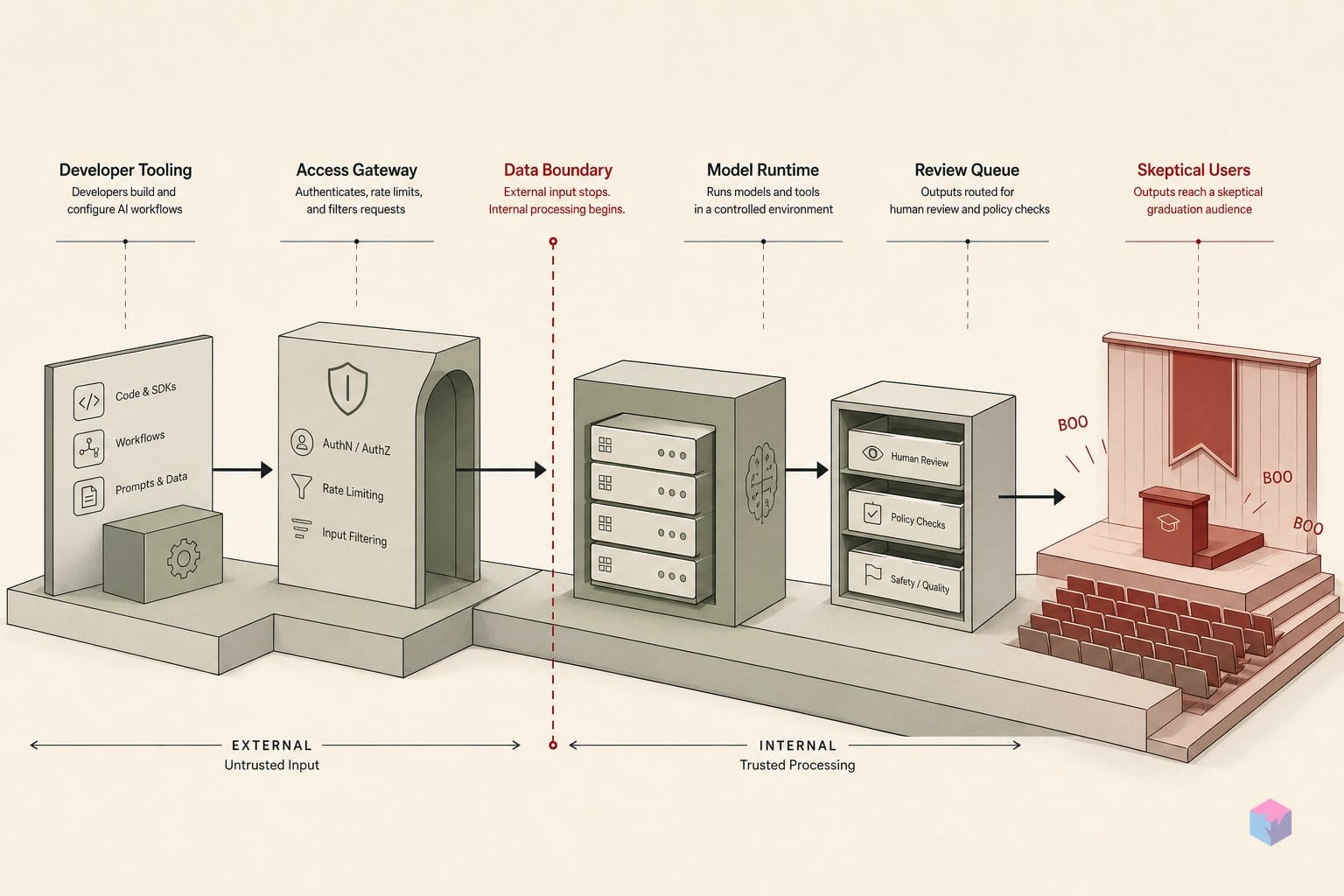
The week of graduation backlash, the AI industry did not pause. According to MIT Technology Review's May 2026 Hype Index, OpenAI was simultaneously "winning court cases, raising enormous sums of money, and launching new partnerships" during the same period that students were booing AI in auditoriums . The same week, Snowflake signed a five-year, $6 billion deal with AWS to secure AI chip access (video: Everything For AI). Enterprise infrastructure commitments at that scale do not correlate with a sector preparing to decelerate.
At the same cultural moment, celebrity AI endorsements were circulating widely — Reese Witherspoon publicly promoting AI adoption, representing a demographic cohort that has fully bought the pitch. This is not cognitive dissonance on the industry's part; it is an accurate read of who is currently purchasing AI products. The demographic that is skeptical — educated young workers entering competitive fields — is not yet the primary revenue driver. But they are the workforce that will operate, extend, and advocate for (or against) the AI tools their employers deploy over the next decade. Revenue now versus talent-layer trust later is the actual tension the contradiction reveals.
"AI is simultaneously jeered by educated young workers and monetized at historic scale." — MIT Technology Review AI Hype Index, May 28, 2026
The MIT Hype Index's "maximum internal contradiction" verdict is not an editorial hedge — it is a precise description of a market structure. Two largely separate demographic cohorts are having entirely different experiences of AI at the same cultural moment. The audience currently paying for your AI product and the audience most likely to resist it may overlap very little. A message that lands for an enterprise buyer ("AI multiplies your team's output") can alienate a junior employee who is already worried about what that multiplication implies for their job. Unified messaging across those two audiences will miss one of them reliably.
Illinois Just Passed America's Strongest AI Safety Law
On or around May 28, 2026, the Illinois legislature passed SB 315 — described by NBC News and Wired as "America's strongest AI safety bill" . The bill cleared the House 110–0 and Senate 52–5 , with Governor J.B. Pritzker announcing he will sign it. Bipartisan margins that large are not reversed by a single legislative swing — this bill is effectively locked in.
SB 315 requires frontier AI companies — specifically OpenAI, Anthropic, and Google DeepMind — to undergo annual independent third-party audits confirming they are following their own stated safety standards. Beyond the audit requirement, the bill covers transparency standards and accountability frameworks for high-risk AI applications in three sectors: hiring, healthcare, and education. Developers shipping AI products that touch any of those three domains for Illinois users will need to track the implementation rulemaking that follows the governor's signature, ahead of enforcement dates that are not yet published.
The endorsement picture is worth noting. Both OpenAI and Anthropic publicly supported the legislation. OpenAI's chief of global affairs stated that "clear expectations around safety, transparency, incident reporting, and accountability matter." Anthropic claimed to be the first AI lab to back the bill. When frontier labs endorse safety legislation, the strategic logic typically includes raising compliance barriers for less well-resourced competitors while reducing long-term regulatory uncertainty — but the endorsements also signal that both labs believe they can clear the requirements. That is different from performative support.
The timing is not incidental. Illinois passed SB 315 the same week as the graduation backlash wave — which means public sentiment and legislative momentum are now moving in the same direction simultaneously for the first time in a sustained way. State-level legislation creates fragmented compliance requirements, but Illinois's scope and bipartisan margins position it as a probable drafting template for subsequent state bills. If you are building AI products for enterprise customers in hiring, healthcare, or education, the Illinois rulemaking calendar is the compliance window to track first.
Is the Gen Z Backlash a Leading Indicator or a Passing Protest?
The easy framing of the graduation booing incidents is theatrical — a cohort performing concern at a culturally amplified moment. That framing deserves scrutiny before accepting. When the same sentiment appears at four separate ceremonies across different institutions and disciplines AND in GoTo survey data showing 46% of Gen Z workers believe AI degrades their cognitive capabilities , the signal is harder to classify as fringe or performative. The GoTo survey was not run at a graduation ceremony.
The historical parallel most often cited here is early educator skepticism of social media, roughly 2008–2012. That skepticism was widely framed as generational friction. It later became mainstream policy concern, platform regulation, and a bipartisan political issue across multiple jurisdictions. The progression was slow and did not prevent adoption — but it fundamentally shaped how those platforms are now governed. The analogy is imperfect (the mechanisms differ substantially), but the dismissal pattern repeats: "they'll adapt" has a weak track record when applied to workers entering industries where AI tools are visibly displacing the entry-level roles those workers trained for.
The 46% of Gen Z workers who feel AI diminishes them are not opting out. Most are entering workplaces that will mandate AI tooling regardless of personal preference. Their skepticism does not block adoption; it shapes the quality of that adoption — specifically, how much friction appears in onboarding, how often tools get used minimally or performatively rather than substantively, and how readily workers support regulatory action against tools they distrust. The graduation boos are the loudest version of a signal that also shows up in usage logs, support tickets, and change management friction rates.
The practical read for AI product builders is concrete. Higher skepticism baselines among junior workers mean that onboarding design, explainability, and trust UI are now competitively differentiated features — not table-stakes afterthoughts. A junior employee who cannot see why an AI made a recommendation will not push back; they will quietly route around the tool or use it in the most mechanical, minimum-viable way. A product that surfaces its reasoning earns the kind of adoption that shows up in usage data, not just activation metrics. The cohort entering the workforce in 2026 is your most important design feedback signal for the next decade. They are telling you what they need to trust the tools they are going to use whether they want to or not.
Frequently Asked Questions
What is MIT Technology Review's AI Hype Index?
The AI Hype Index is an editorial series published by MIT Technology Review, running roughly every two to three months since April 2025 . It is explicitly described as a "highly subjective take on the latest buzz about AI" — not a quantitative index or scored system. Each edition tracks boosting and deflating signals simultaneously and renders a net verdict on AI momentum, which means a single edition can report contradictory signals without collapsing them. The May 2026 edition, published May 28, issued a "maximum internal contradiction" reading: AI simultaneously booed at commencement ceremonies and funded at record scale in the same week.
Why were students booing AI at 2026 graduation ceremonies?
Students at at least four US commencement ceremonies in May 2026 booed speakers who praised AI adoption. The pattern was consistent: backlash was loudest when speakers used boosterism framing that dismissed job displacement concerns, and softer when speakers acknowledged real tradeoffs. Incidents occurred at UCF's College of Arts and Humanities (May 8), Middle Tennessee State University (May 9), the University of Arizona (May 16–18), and Glendale Community College, Arizona. The sentiment is backed by survey data: 46% of Gen Z workers believe AI is degrading their cognitive capabilities, compared to 39% of workers overall, according to GoTo research from May 2026 .
How did Eric Schmidt respond to being booed at his commencement speech?
At the University of Arizona, May 16–18, 2026 , Schmidt received what MIT Technology Review described as "a resounding chorus of boos." His response was notable for conceding the stakes: he described student fears about "disappearing jobs and a broken future" as "rational" — a concession that received less negative audience response than his boosterism framing. Schmidt still urged graduates to assemble teams of AI agents for their careers. The acknowledgment-before-pitch model fared measurably better than the flat dismissals deployed by other speakers — a relevant data point for positioning AI tools to skeptical audiences.
What does the Illinois AI safety bill require from developers?
SB 315, passed by the Illinois legislature in late May 2026 by a 110–0 House vote and 52–5 Senate vote , requires frontier AI companies (OpenAI, Anthropic, Google DeepMind) to undergo annual independent third-party audits confirming they follow their own stated safety standards. It also covers transparency requirements and accountability standards for high-risk AI applications in hiring, healthcare, and education, plus audit obligations for deployers in those sectors. Governor J.B. Pritzker has announced he will sign the bill. Full implementation requirements will emerge from post-signature rulemaking — developers shipping into Illinois-regulated sectors should begin tracking that calendar now, ahead of enforcement dates.
Does Gen Z backlash actually translate into lower AI adoption?
Not immediately. Most Gen Z workers will use employer-mandated AI tools regardless of personal preference — the labor market leaves limited room for principled non-adoption at scale. The downstream effects are subtler and more durable: lower voluntary adoption in creative fields, higher support for AI regulation (consistent with Illinois SB 315's political context), and lower tolerance for opaque AI UX that automates without explaining. The 46% who believe AI degrades their cognition are likely to use mandated tools minimally or performatively rather than substantively — a pattern visible in usage depth metrics but invisible in adoption rate statistics. Explainability and trust UI design are the primary levers for converting reluctant adopters into genuine users over time.
Watch / Sources
What This Means for What You're Building
The MIT Technology Review AI Hype Index's "maximum internal contradiction" reading for May 2026 is a market structure description, not an editorial shrug. Two largely separate demographic cohorts — enterprise buyers and capital markets on one side, educated young workers entering competitive labor markets on the other — are having entirely different experiences of AI at the same cultural moment. Products designed for the first cohort and deployed onto the second will encounter the friction the graduation data makes legible. That friction is not irrational; it is based on concrete observation about what AI tools are doing to the skills workers need to compete in the fields they trained for.
The Illinois AI safety bill adds a regulatory dimension that is no longer speculative. Bipartisan margins of 110–0 and 52–5, frontier lab endorsements from OpenAI and Anthropic, and a governor ready to sign — this is not a distant threat to monitor from a distance. If your product touches hiring, healthcare, or education in Illinois, the compliance window opens at rulemaking, not enforcement. Designing for auditability and visible reasoning from the start is cheaper than retrofitting it under regulatory deadline pressure, and it also happens to be what the skeptical user cohort needs to trust the tool in the first place.
The Gen Z signal is both user research and a product design brief. The workforce cohort entering in 2026 is telling you directly what builds trust: visible reasoning, explainable outputs, workflows where the human contribution stays legible and contestable. These are not compliance features bolted on for regulators. They are the design characteristics that convert a tool people comply with into a tool people actually extend and advocate for. The booing at graduation ceremonies is the loudest version of a signal that will show up in your onboarding drop-off rates, your support tickets, and your usage analytics. Design for the skeptic, and you earn the enthusiast by default.
Last updated: 2026-06-01. This article draws on MIT Technology Review's May 28, 2026 AI Hype Index, GoTo and Lumina Foundation–Gallup survey data from May 2026, NBC News and Wired reporting on Illinois SB 315, and coverage from HuffPost, Government Technology, and Tom's Hardware on the commencement incidents.