What GPT-Rosalind Is Built For
GPT-Rosalind is OpenAI's first domain-specific frontier model scoped exclusively to biology, drug discovery, and translational medicine. Introduced on April 16, 2026 and named after X-ray crystallographer Rosalind Franklin — whose diffraction imaging was pivotal in determining DNA's double-helix structure — the model is not positioned as a general upgrade over GPT-5.4. OpenAI claims no advantage on coding, broad reasoning, or non-biology benchmarks. The design is deliberately narrow: domain depth is the stated value, not a limitation to be patched later. According to OpenAI's launch documentation, the model was purpose-built to reason natively about molecules, proteins, genes, and disease-relevant biology at the level that matters for translational research pipelines.
Quick Answer: GPT-Rosalind is a biology-only domain model launched April 16, 2026, initially restricted to U.S. enterprise Trusted Access. On BixBench, it scores 0.751 pass@1 versus GPT-5.4's 0.732. The May 29 Biodefense Program adds free sponsored access for academic, nonprofit, and government-affiliated organizations globally. No general API is available — entry is application-only at both tiers.
The model's practical task scope covers six categories of bioinformatics work: synthesizing and cross-referencing scientific literature across disconnected research corpora; parsing sequencing and genomic data; planning molecular experiments including CRISPR guide RNA design; designing cloning protocols and selecting enzyme reagents; and orchestrating multi-step queries across biological databases at inference time — not just as a retrieval layer but as an active reasoning participant. These are contexts where domain-specific pre-training should outperform a system-prompted general model, and the benchmark results below suggest it does, with varying margins across task families.
The commercial launch partner list signals the intended deployment tier. Amgen, Moderna, Thermo Fisher, UCSF, Benchling, NVIDIA, the Allen Institute, and Oracle Health are large pharmaceutical companies, academic medical centers, and infrastructure vendors — all with the compliance infrastructure to operate under enterprise Trusted Access agreements. Smaller teams, academic labs, and public health agencies had no access path at all until the Biodefense Program changed that on May 29.
BixBench and LABBench2: How the Scores Stack Up
OpenAI benchmarked GPT-Rosalind against three comparators — GPT-5.4, Grok 4.2, and Gemini 3.1 Pro — on two domain-specific evaluation suites. On BixBench, a bioinformatics agent benchmark measuring agentic task completion across database queries and sequence parsing, GPT-Rosalind achieved a pass@1 score of 0.751 . The nearest competitor is GPT-5.4 at 0.732 — a gap of 0.019, which is narrow but consistent with what you'd expect from a general model with strong biology coverage versus a domain-trained one. Grok 4.2 scored 0.698 and Gemini 3.1 Pro scored 0.550 , neither of which is a biology-specialized model.
| Model | BixBench pass@1 | LABBench2 vs. GPT-5.4 | Biology-specialized? |
|---|---|---|---|
| GPT-Rosalind | 0.751 | Leads on 6 of 11 task families; largest gap in CloningQA | Yes — domain-trained |
| GPT-5.4 | 0.732 | Baseline | No — general model |
| Grok 4.2 | 0.698 | Not reported | No — general model |
| Gemini 3.1 Pro | 0.550 | Not reported | No — general model |
On LABBench2 — a 1,900-task biology research suite spanning multiple task families — GPT-Rosalind outperforms GPT-5.4 on 6 of 11 task categories. The largest performance margin is in CloningQA, which covers DNA and enzyme design protocols — the most directly domain-specific family in the suite. The model does not lead on all 11 families; on the remaining five, GPT-5.4 holds or the gap is not disclosed. Domain specialization pays off selectively, not uniformly across all biology subfields.
Apply the standard skepticism filter before treating any of this as settled. All figures are OpenAI-reported . Parameter count, training compute, and training data composition are undisclosed. No third-party audit of the benchmark methodology has been published. Observers tracking the announcement on technical forums have noted that the May 2026 launch materials lack the operational detail needed to independently validate these claims . Until an independent replication appears on BixBench or LABBench2, treat these as vendor-claimed numbers with no external verification.
A second constraint worth being explicit about: BixBench measures agentic bioinformatics performance in a digital context — database queries, sequence parsing, structured retrieval, and protocol generation as text outputs. It does not assess wet-lab execution fidelity or the model's ability to predict experimental outcomes in physical chemistry. A high CloningQA score means the model produces well-structured cloning protocol text; it does not mean the protocol will succeed on a bench without expert review. The evaluation scope is bounded by design, and deployers should not extrapolate from in-silico task performance to end-to-end experimental reliability.
The Biodefense Program: Eligibility, Funding, and Vetting
The Rosalind Biodefense Program, announced May 29, 2026 , changes the access equation that the April Trusted Access launch left closed for most biology researchers. The April tier was restricted to qualified U.S. enterprise customers with the procurement infrastructure to enter commercial agreements with OpenAI — effectively a large-pharma and research-hospital tier. The Biodefense Program broadens this to academic institutions, nonprofits, government-affiliated bodies, and small-to-mid-sized teams, with global eligibility rather than a U.S.-only constraint, according to The Decoder's reporting on the launch .
The funding model is the most significant structural difference from the April tier: OpenAI covers costs for approved participants. This sponsored-access design removes the pricing barrier that excluded most public health institutions, academic research groups, and international biosurveillance organizations from the initial cohort. Whether cost coverage extends to compute-intensive agentic workflows or is capped at lighter usage profiles has not been disclosed.
Entry is application-based for both tiers. There is no consumer access and no general API availability as of May 2026 . Applications are accepted through OpenAI's Biodefense Program intake form. Review timelines, the criteria weighting for non-U.S. applicants, and the vetting process duration have not been published. Access is not first-come-first-served — qualification is the gate, not submission order.
The stated target lifecycle covers prevention, early detection, biosurveillance, epidemiological modeling, non-pharmaceutical interventions, screening, medical countermeasure development, and vaccine development . That scope spans the full arc from threat identification through response deployment — disciplines (epidemiology, molecular biology, public health policy, clinical trial design) that a single model cannot address uniformly. Applicants benefit from mapping their specific use case precisely to one of these lifecycle stages when applying, since vetting appears designed to screen for demonstrated public health benefit rather than general research interest in AI biology tools.
Early Program Partners and What Their Inclusion Tells Us
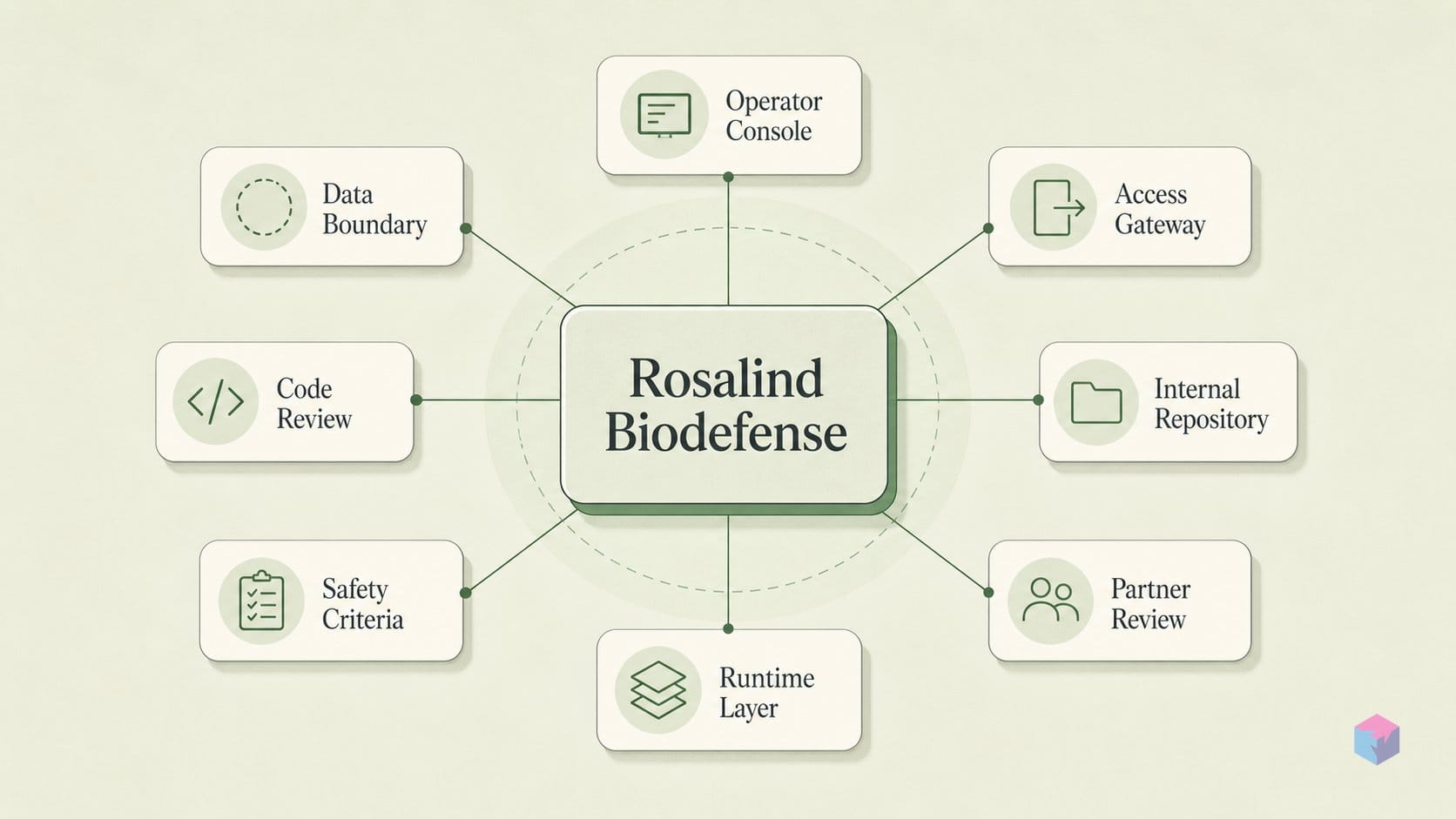
The Biodefense Program's initial partner set — Lawrence Livermore National Laboratory, Johns Hopkins Applied Physics Laboratory, CEPI, Fourth Eon, and SecureDNA — is not a random academic sampling. Read as a signal, the composition tells you more about the program's actual priorities than the press materials do: national-security intelligence infrastructure, pandemic vaccine finance, commercial biosurveillance, and dual-use screening are all represented in the launch cohort simultaneously.
Lawrence Livermore National Laboratory and Johns Hopkins Applied Physics Laboratory are both institutions with active national-security and threat-intelligence programs. Their inclusion signals that the program is framed at least partly around state-actor biological threats, not only emerging infectious disease or academic discovery. This distinction matters: it places GPT-Rosalind in a defense-intelligence context from its first operational deployment, not merely a public-health context that defense organizations happen to share.
CEPI — the Coalition for Epidemic Preparedness Innovations — provides the counterweight. CEPI's mandate is rapid vaccine development for emerging pathogens with global pandemic potential, and its funding base is international rather than U.S.-centric . Its presence confirms that the program's stated global eligibility is not decorative.
SecureDNA's inclusion is arguably the most architecturally significant partner choice. SecureDNA operates DNA synthesis screening infrastructure — the technical layer that prevents commercial gene synthesis providers from fulfilling orders for sequences associated with dangerous pathogens. Embedding a synthesis-screening partner in the launch portfolio makes the dual-use prevention architecture explicit at program inception rather than as a retrofit. Fourth Eon adds a commercial biosurveillance dimension; its inclusion signals that private-sector threat intelligence is also in scope.
"The Rosalind Biodefense Program brings together leading national security laboratories, pandemic preparedness institutions, and biosecurity infrastructure providers to accelerate AI-assisted biological threat response across the full prevention-to-vaccine lifecycle." — OpenAI, Strengthening Societal Resilience with Rosalind Biodefense, May 2026
OpenAI also briefed the White House and several U.S. federal agencies ahead of the May 29 launch . Pre-launch government briefings are not standard for AI model releases; they indicate the program is positioned as an active component of U.S. biosecurity policy infrastructure, not a commercial product with a biodefense marketing angle layered on top.
Safety Controls and Governance: What OpenAI Has Disclosed
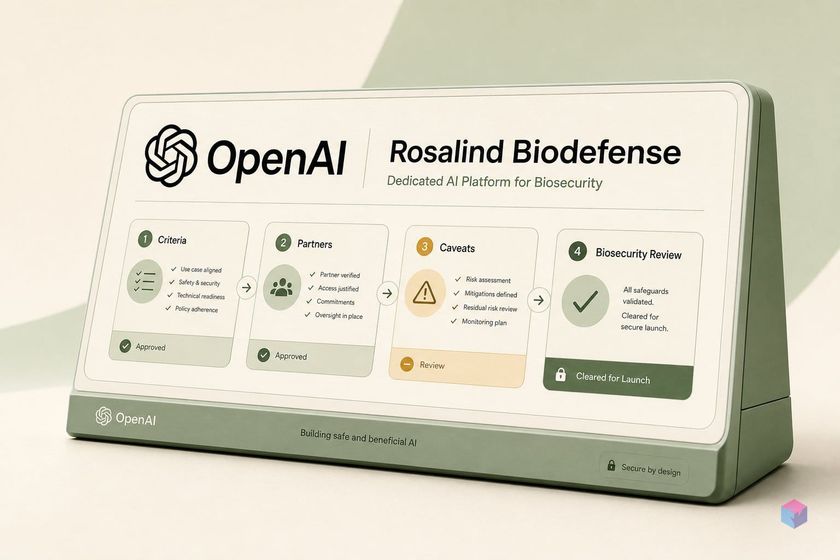
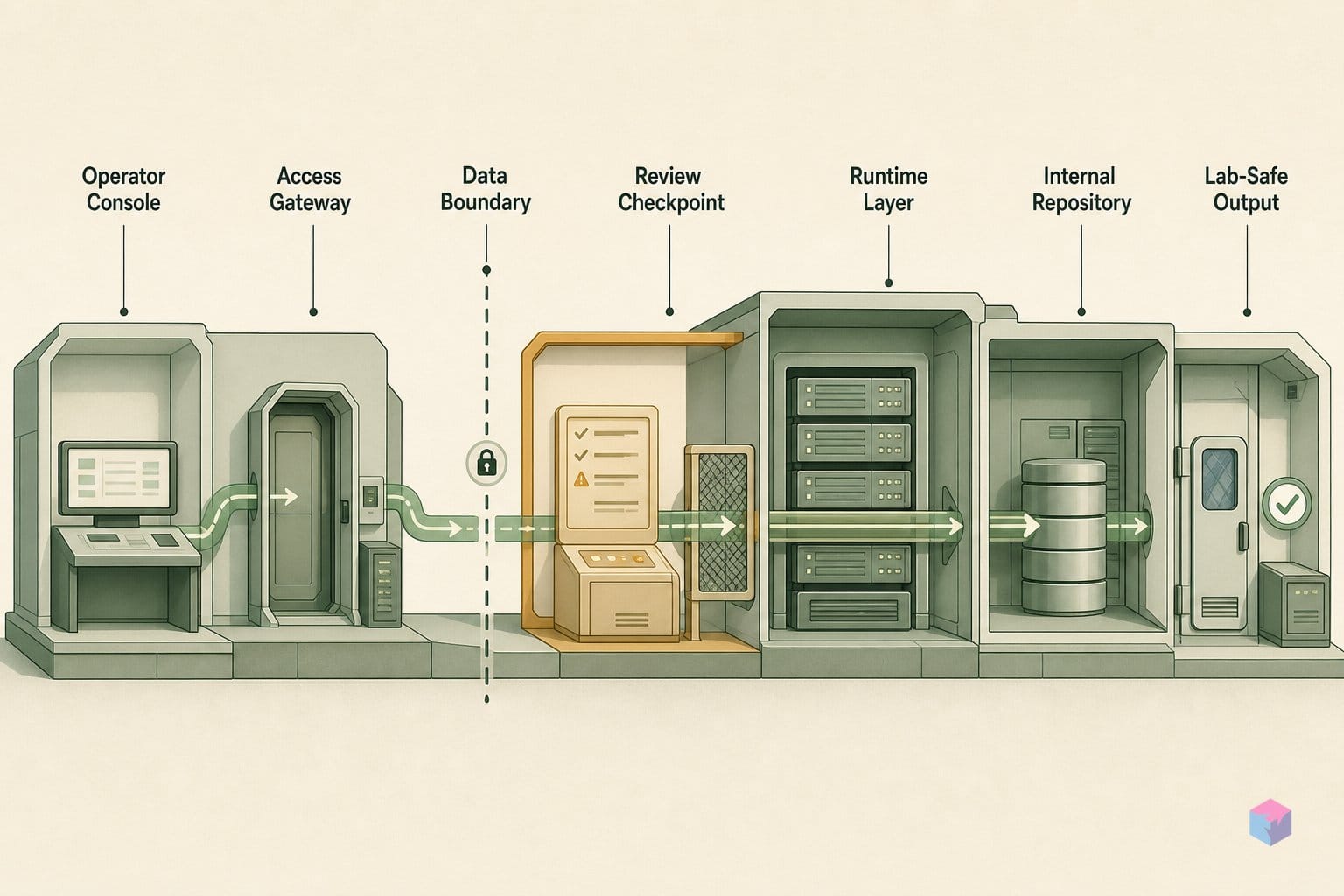
OpenAI describes a three-layer safety framework governing GPT-Rosalind access. Layer 1 is enterprise-grade application vetting — all participants are screened before access is granted. Layer 2 consists of technical safeguards embedded in the model itself, designed to flag potentially dangerous queries at inference time. Layer 3 is ongoing monitoring tied to the program's governance structure . This is the complete public disclosure — three governance-level descriptions with no published technical implementation details for any of them.
"AI has massive implications for biosecurity, including the creation of biological weapons." — OpenAI, per Axios, May 2026
The acknowledgment is direct and the dual-use risk is explicitly named. What is absent is the technical architecture that follows from that acknowledgment. OpenAI has not published the content-classification mechanism determining when a query is flagged, the refusal rate or refusal policy for ambiguous queries, the red-team methodology used to stress-test the model before deployment, or the specific criteria that constitute a "dangerous query" at inference time. These are not minor operational details — they are the load-bearing components of any biosecurity-grade containment claim.
Layer 1 vetting addresses who receives access, not what the model will do once access is granted. A vetted academic institution could still construct queries that inadvertently probe dual-use capability boundaries. Without a published content-filtering architecture, it is not possible to evaluate externally how Layer 2 handles near-boundary queries — for example, literature synthesis requests that span both defensive epidemiology and pathogen characterization research where the difference is largely a matter of framing.
Layer 3 — ongoing monitoring — is the most opaque element. The following questions have no published answers as of May 2026 : What triggers a monitoring review? Who reviews flagged outputs? What are the escalation paths for incidents? What governance structure oversees international program participants where U.S. legal jurisdiction does not apply?
For developers evaluating whether to apply or advise clients to apply: the safety posture is governance-forward but technically opaque. The vetting process is real, the monitoring commitment is stated, and the partner portfolio includes genuine biosecurity infrastructure. But the containment architecture is not independently verifiable from the information OpenAI has published. Anthropic's responsible scaling policy — which includes a published biosecurity tier with defined capability thresholds and a methodology for determining when additional containment requirements are triggered — offers a reference point for what a specification-forward disclosure looks like in this domain. The comparison is informative rather than definitive; both approaches have gaps, but the gap in public documentation is larger on OpenAI's current disclosure.
The Free Life Sciences Plugin vs. Full Rosalind
Alongside GPT-Rosalind's April launch, OpenAI released a free Life Sciences plugin that connects mainstream OpenAI models to more than 50 public biological databases — including AlphaFold (protein structure predictions), Bgee (gene expression data), and BindingDB (molecular binding affinities). The plugin requires no Trusted Access clearance and no application. According to NerdLevelTech's technical overview of the launch, it is immediately available to researchers who don't qualify for the Biodefense Program or the enterprise tier — and it is the practical starting point for most teams evaluating whether GPT-Rosalind's additional capabilities are actually worth applying for.
| Feature | Life Sciences Plugin (free) | GPT-Rosalind (Biodefense / Enterprise) |
|---|---|---|
| Cost | Free, no application | OpenAI-sponsored for approved Biodefense orgs; enterprise pricing otherwise |
| Access requirement | None | Application + vetting required |
| Underlying model | Mainstream OpenAI models (e.g., GPT-5.4) | Domain-trained GPT-Rosalind |
| Biological databases | 50+ public databases (AlphaFold, Bgee, BindingDB) | Multi-database orchestration at inference time |
| Reasoning mode | Retrieval augmentation over fetched context | Domain-native biological reasoning from trained weights |
| Protocol planning | Limited — model is not domain-trained | Multi-step cloning and CRISPR protocol design |
| Best fit | Database lookup, literature bridging, quick reference | Deep molecular reasoning, cross-database orchestration, protocol generation |
The functional distinction is not about which tool can access a biological database — both can. The distinction is what happens after retrieval. The plugin fetches relevant context from databases and passes it to a general model that then reasons over retrieved documents. GPT-Rosalind reasons natively about molecular biology, which means it generates and evaluates multi-step experimental plans — CloningQA-type tasks — from domain knowledge embedded during training, not only from documents retrieved at query time. For well-indexed retrieval tasks, the plugin covers most ground. For tasks requiring the model to hold a multi-step experimental reasoning chain across multiple database outputs simultaneously, the domain-trained model's architecture is the relevant differentiator.
For developers building biology-adjacent tools or advising researchers, the decision heuristic is: use the plugin when your workflow involves database lookup, cross-referencing literature, or bridging between data sources. Apply to GPT-Rosalind when your workflow requires native molecular reasoning — protocol design, CRISPR guide evaluation, multi-database orchestration — where a domain-trained model's embedded reasoning patterns should outperform a retrieval-augmented general model. The BixBench and LABBench2 data, with all vendor-reporting caveats applied, support this task-level split in the categories where Rosalind leads most decisively.
Dual-Use Tensions and What Remains Unresolved

The dual-use problem in AI biology tooling is architectural, not merely political. The capabilities enabling GPT-Rosalind to synthesize literature, plan experimental protocols, and reason about molecular interactions are structurally similar to capabilities that could assist offensive biological research. The line between a defensive biosurveillance query and a query that aids pathogen enhancement is, in many cases, a matter of framing and intent rather than a technical boundary the model can reliably detect at inference time. Governance — vetting, monitoring, flagging — is the primary containment mechanism, not the model architecture itself.
OpenAI acknowledged this tension publicly and explicitly . What it has not published is the technical specification of its containment approach: how near-boundary queries are handled, what the refusal policy covers for ambiguous requests, and how the inference-time flagging system distinguishes defensive from potentially harmful reasoning chains. Technical observers noted this gap at the May 2026 launch, questioning whether the announcement provided sufficient operational detail to evaluate the program's actual biosecurity capabilities .
The specific unresolved questions as of publication:
- Refusal rate on ambiguous queries: Not disclosed. No data on how frequently the model declines near-boundary requests or the criteria applied at the decision boundary.
- Red-teaming methodology: Not published. Who tested the model's dual-use surface before deployment, what scenarios were evaluated, and what findings shaped the safety controls are all undisclosed.
- Governance for international partners: The Biodefense Program has global eligibility, but the oversight structure for non-U.S. participants — where U.S. export control and legal jurisdiction may differ — is not specified.
- Independent audit pathway: No third-party biosecurity audit of the model has been announced.
Two independent reference points are worth consulting when evaluating OpenAI's stated posture. Anthropic's responsible scaling policy defines biosecurity capability thresholds with a published methodology for determining when additional containment requirements are triggered. MIT Lincoln Laboratory's biosecurity benchmarks offer evaluation criteria independent of any vendor's self-reported figures. Neither is a definitive external standard for GPT-Rosalind specifically, but both provide reference frames for assessing what "adequate biosecurity disclosure" looks like relative to what OpenAI has currently published. For developers advising organizations integrating AI into biosurveillance or public health infrastructure, the absence of equivalent technical disclosure is a fact pattern to surface explicitly in procurement and compliance conversations, not a reason to dismiss the program outright.
Frequently Asked Questions
Is GPT-Rosalind available via public API?
No. As of May 2026, GPT-Rosalind is not available through a public API or consumer product. Access requires either enrollment in the enterprise Trusted Access Program — the April 2026 tier restricted to qualified U.S. enterprises — or approval through the Rosalind Biodefense Program, launched May 29, 2026, with global eligibility. Both paths require an application and are subject to vetting. No general API availability has been announced by OpenAI.
How does GPT-Rosalind differ from GPT-5.4 used with a biology system prompt?
GPT-Rosalind is domain-trained, not system-prompted. Biological reasoning patterns are embedded in the model weights during training, rather than injected via instructions at inference time. On BixBench, it scores 0.751 pass@1 versus GPT-5.4's 0.732. On LABBench2 (1,900 tasks), it outperforms GPT-5.4 on 6 of 11 task families, with the largest margin in CloningQA — DNA and enzyme design protocol tasks. For general reasoning, coding, or non-biology tasks, OpenAI claims no advantage. The domain specialization is the design, not a tradeoff to be resolved in a later version.
Who qualifies for the Rosalind Biodefense Program?
Academic institutions, nonprofit organizations, government-affiliated bodies, and small-to-mid-sized teams with a demonstrated public health benefit are the stated eligibility categories. Global eligibility applies — the program is not restricted to U.S. organizations, unlike the April Trusted Access tier. Access is application-based and subject to OpenAI vetting; it is not first-come-first-served. Review timelines and the relative weighting of eligibility criteria for international applicants have not been published. Applications are accepted through OpenAI's Biodefense Program form.
What does the Life Sciences Plugin offer without applying to any program?
The Life Sciences plugin is free and requires no Trusted Access clearance or Biodefense Program application. It connects mainstream OpenAI models to more than 50 public biological databases, including AlphaFold (protein structure), Bgee (gene expression), and BindingDB (molecular binding data). It is effective for database lookup, literature bridging, and cross-referencing between biological data sources. It is not a substitute for GPT-Rosalind's domain-native reasoning: the plugin augments a general model with retrieved context, whereas Rosalind generates and evaluates multi-step experimental reasoning from domain-trained weights, which is the relevant distinction for protocol design and molecular reasoning tasks.
What are the known gaps in GPT-Rosalind's safety documentation?
OpenAI has described three governance layers — application vetting, inference-time query flagging, and ongoing monitoring — but has not disclosed the technical implementation of any of them. The following are specifically absent from public documentation as of May 2026: the content-classification mechanism that determines when a query triggers a flag, the refusal rate or refusal policy for ambiguous or near-boundary requests, the red-teaming methodology and findings that informed the safety controls, and the governance oversight structure for international program participants. The dual-use risk is publicly acknowledged, but the containment architecture is not independently verifiable from currently available materials.
What to Track From Here
GPT-Rosalind and the Biodefense Program are early-stage in terms of public documentation. The April enterprise launch established the commercial tier; the May 29 Biodefense Program opened an access path for academic, nonprofit, and government-affiliated organizations that the initial rollout excluded. The program's actual impact will be visible in three places: whether independent benchmark reproductions of the BixBench and LABBench2 figures appear from external researchers; whether OpenAI publishes technical biosecurity disclosure comparable to what other frontier labs have released under their safety frameworks; and whether the composition of future program partner cohorts expands beyond the current national-security-and-pandemic-preparedness framing into a broader public health research base.
For developers, the decision surface is relatively clean at this stage. The Life Sciences plugin is the no-friction starting point for any biology-adjacent tooling work — free, immediate, no application overhead. GPT-Rosalind's Biodefense Program is the relevant path if your use case involves deep molecular reasoning, multi-step protocol design, or multi-database orchestration at inference time, and your organization fits the eligibility categories. If you are advising a larger organization on biosecurity AI integration, the gaps in OpenAI's technical safety documentation — refusal rates, red-team findings, governance architecture — are known unknowns to flag explicitly to compliance stakeholders before any deployment decision, not details that can be assumed to be resolved behind the scenes.
The model's launch also marks a broader pattern shift in how OpenAI is structuring its model portfolio. Domain-specific variants, gated by use case and accessed through structured programs rather than open APIs, appear to be an emerging deployment architecture alongside the general-purpose API. If GPT-Rosalind demonstrates measurable value in production deployments, analogous program structures in other high-stakes domains — legal, clinical, materials science — are a reasonable expectation. The access model, as much as the model itself, is worth watching.
Last updated: 2026-05-30. This article reflects information available at the time of the Rosalind Biodefense Program's public launch on May 29, 2026. Benchmark data, access terms, and safety disclosures may be updated as OpenAI publishes additional documentation.