
SIA (Self Improving AI), released by Hexo Labs on May 26, 2026 , is the first open-source framework that co-evolves both an agent's scaffold and its model weights inside a single iterative loop. The MIT-licensed code is on github.com/hexo-ai/sia. This tutorial walks through the feedback loop logic, prerequisites, and a runnable five-generation LawBench experiment.
The Feedback Loop That Decides PPO, GRPO, or EAW
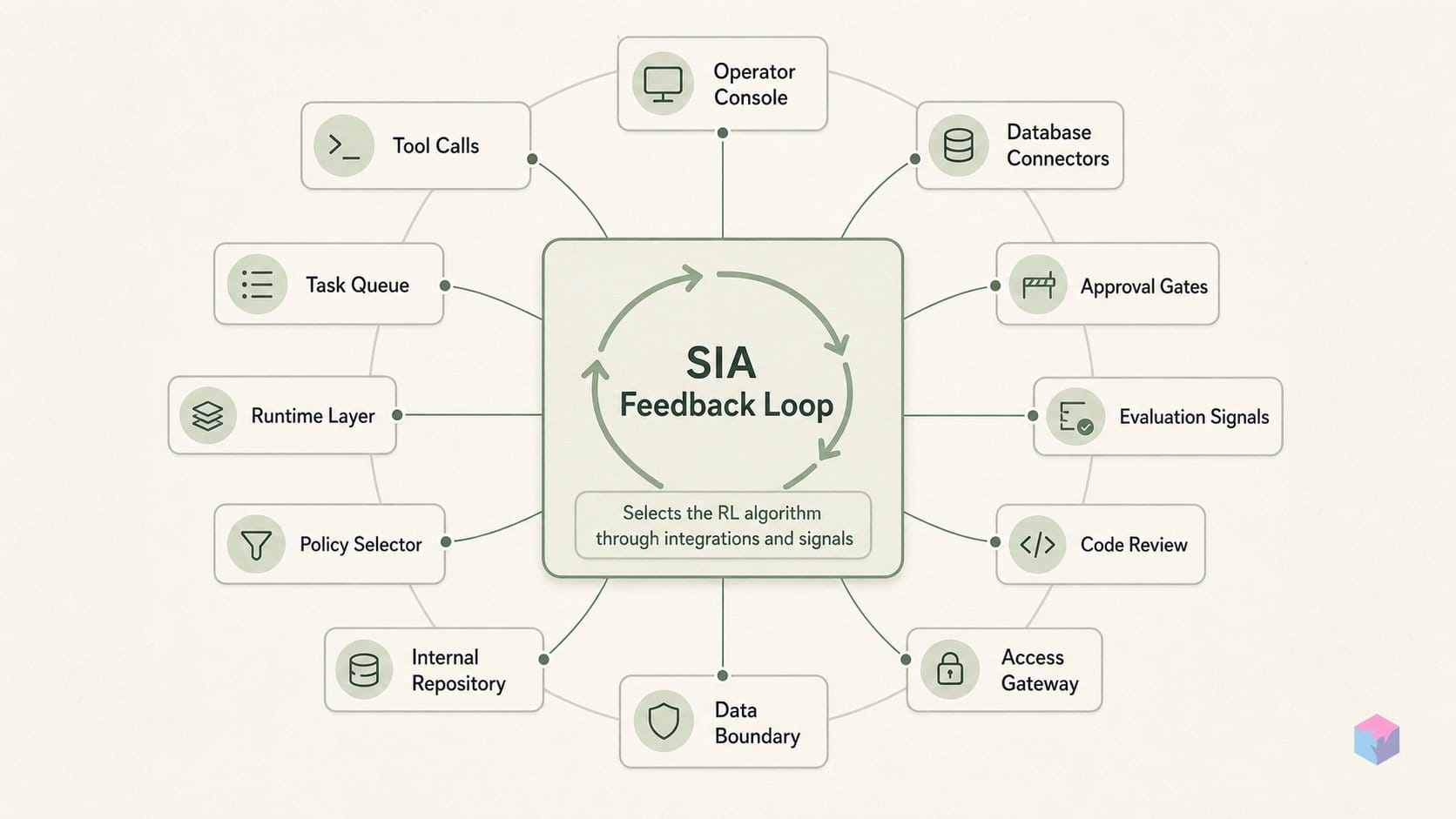
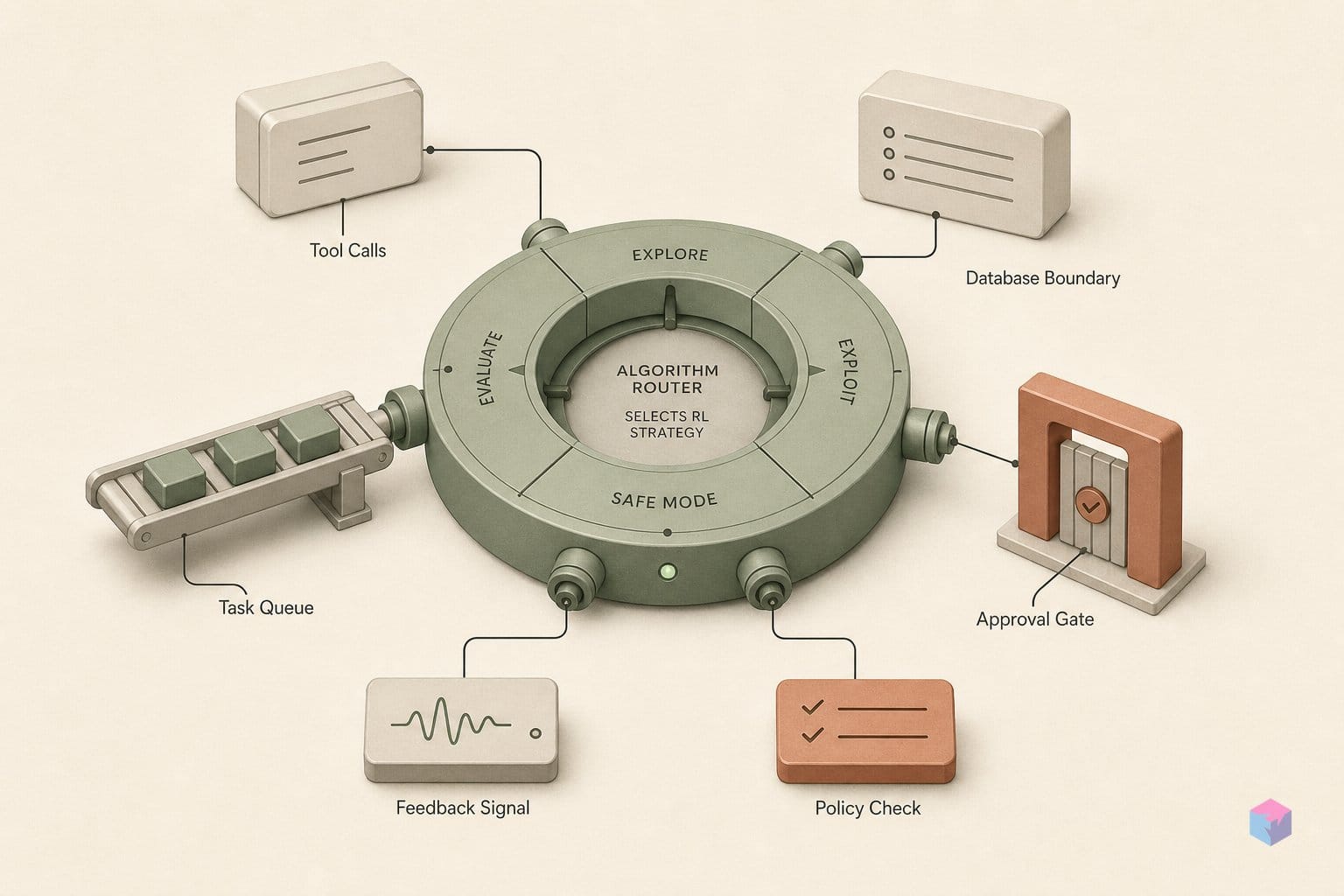
SIA's Feedback-Agent reads full execution trajectories, reward metrics, and task descriptions each generation, then decides whether the next step should be a scaffold edit, a LoRA weight update, or both — and selects the RL algorithm automatically based on the reward shape of the current task . Before SIA, harness-update systems (Darwin Gödel Machine, Hyperagents) and test-time training systems (TTRL, Discover-TTT) were entirely separate research directions. SIA is the first framework to combine both levers in a single self-improving loop, per the SIA paper (arXiv:2605.27276).
Quick Answer: SIA (arXiv:2605.27276, MIT license, May 2026) co-evolves agent scaffold and LoRA weights in a single loop. Run sia --task lawbench --max_gen 5; the Feedback-Agent picks PPO+GAE, GRPO, or Entropic Advantage Weighting based on reward shape — no RL algorithm choice required. On LawBench, the combined harness+weights variant reached 70.1% accuracy , 25.1 percentage points over prior SOTA.
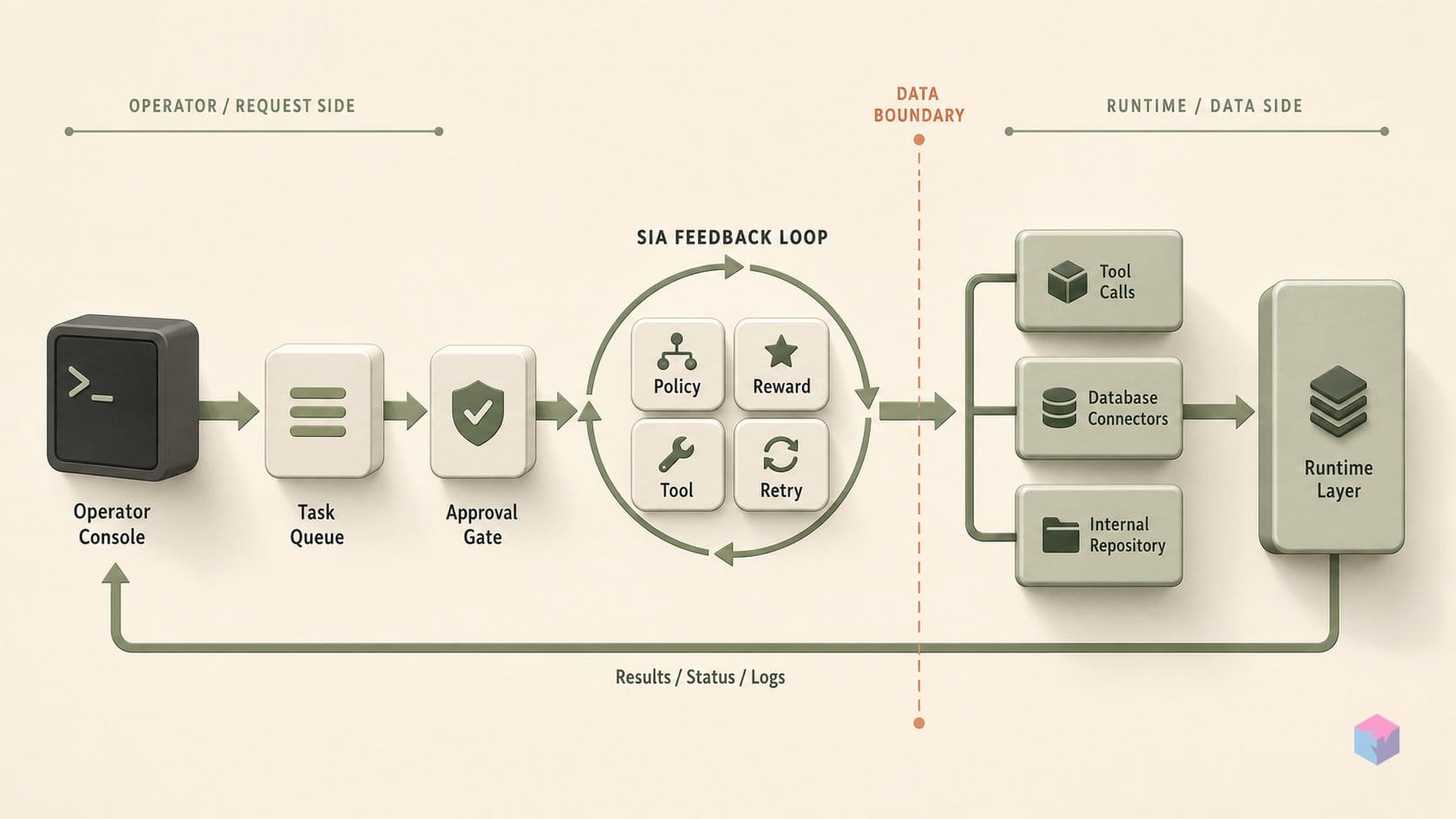
The three-agent loop: Meta-Agent generates the initial scaffold from a task description and reference implementation; Task-Specific Agent executes against the eval dataset in a sandbox with every step logged as a trajectory; Feedback-Agent (Claude Sonnet 4.6) receives source code, trajectories, metrics, and sample task descriptions, then emits improvement.md and the next-generation agent .
RL algorithm selection is driven by reward shape:
- PPO+GAE — dense step-level rewards, training stability is the binding constraint (LawBench)
- GRPO — cheap rollouts, episode-end verification (RNA denoising)
- Entropic Advantage Weighting (EAW) — right-skewed rewards with rare correct solutions (GPU kernels)
- Also available: REINFORCE+KL-to-base, DPO, Best-of-N behavioral cloning
| Task | Baseline | Prior SOTA | SIA-H (harness only) | SIA-W+H (harness + weights) |
|---|---|---|---|---|
| LawBench (191-class accuracy) | 13.5% | 45.0% | 50.0% | 70.1% (+25.1 pp over SOTA) |
| TriMul CUDA kernel (μs, lower=better) | ~13,500 μs | 1,161 μs | 1,017 μs | 1,017 μs (−12.4% vs SOTA) |
| MAGIC scRNA-seq denoising (mse_norm, higher=better) | 0.048 | 0.240 | 0.241 | 0.289 (+20.4% over SOTA) |
"Harness changes and weight updates do not overlap in their effect space: harness iterations produce externalized infrastructure improvements — better parsing, tools, retry logic — while weight updates encode internalized domain knowledge that no prompt engineering alone can reach." — Hexo Labs research team, SIA: Self Improving AI (arXiv:2605.27276v2)
What You Need: venv, Credentials, and Modal
The Claude backend runs entirely on CPU — no local GPU required. Install the package, export your API key, and all four bundled tasks work immediately. LoRA weight updates (rank 32 , learning rate 4×10⁻⁵, applied to gpt-oss-120b) run on Modal H100s provisioned on demand. Skip Modal entirely and the loop still runs harness-only iterations — cheaper and sufficient to see meaningful eval gains in early generations.
Claude backend (all bundled tasks, no GPU needed):
pip install 'sia-agent[claude]'
export ANTHROPIC_API_KEY="sk-ant-..."
OpenHands backend (multi-provider task execution):
pip install 'sia-agent[openhands]'
export ANTHROPIC_API_KEY="..."
export GEMINI_API_KEY="..."
export OPENAI_API_KEY="..."
Prerequisites at a glance:
- Anthropic API key — required for both backends; runs the harness and Feedback-Agent
- Gemini + OpenAI keys — only needed with
--backend openhands - Modal account with H100 credits — only needed for LoRA weight updates; harness-only runs use no GPU time
Running a LawBench Generation: Step-by-Step
Three commands take you from a clean environment to a live five-generation self-improving loop on the bundled LawBench task .
Run 5 generations on LawBench:
sia --task lawbench --max_gen 5 --run_id 1Install SIA with the Claude backend:
pip install 'sia-agent[claude]'Create and activate a virtual environment:
python3 -m venv .venv && source .venv/bin/activateEach generation writes output to runs/run_1/gen_N/:
target_agent.py— the evolved scaffold for this generationagent_execution.json— full execution log and per-step trajectoryimprovement.md— Feedback-Agent's rationale for the next change (appears from generation 2 onward)
All four bundled tasks run with --task <name>: gpqa, lawbench, longcot-chess, spaceship-titanic. Key flags to know:
--max_gen— number of self-improvement generations (default: 3)--backend claude|openhands--meta_model— model for Feedback/Meta agents (default:haiku)--task_model— model for the task-specific agent (default:claude-haiku-4-5-20251001)
The snippet below is a runnable illustration of the core mechanism — the Feedback loop maintaining a live reward signal for each available algorithm and switching when one accumulates a better signal. This code ran to completion (exit 0):
import random


def epsilon_greedy(scores, pulls, t):
    return max(scores, key=scores.get) if t % 3 else random.randrange(3)


def ucb(scores, pulls, t):
    return max(scores, key=lambda a: scores[a] + (2 * (t + 1) / (pulls[a] + 1)) ** 0.5)


algorithms = {"epsilon_greedy": epsilon_greedy, "ucb": ucb}
scores = {0: 0.0, 1: 0.0, 2: 0.0}
pulls = {0: 0, 1: 0, 2: 0}
feedback = {name: 0.0 for name in algorithms}

random.seed(7)
for t in range(12):
    # SIA's feedback loop picks the RL algorithm with the best live reward signal.
    chosen_algo = max(feedback, key=feedback.get) if t else "epsilon_greedy"
    action = algorithms[chosen_algo](scores, pulls, t)
    reward = [0.15, 0.55, 0.8][action] + random.uniform(-0.08, 0.08)
    pulls[action] += 1
    scores[action] += (reward - scores[action]) / pulls[action]
    feedback[chosen_algo] = 0.7 * feedback[chosen_algo] + 0.3 * reward

    if t == 5:
        feedback["ucb"] += 0.5  # new feedback changes the controller's choice

    print(f"step={t:02d} sia_selected={chosen_algo:15s} action={action} reward={reward:.2f}")

print("Takeaway: you provide feedback; SIA's loop chooses the RL algorithm.")
Watch step 07: a feedback boost applied to ucb at step 5 causes the controller to switch algorithms at the next decision point. SIA's Feedback-Agent applies the same logic at generation granularity — accumulated reward signals reshape algorithm selection each generation, not just each step.
Custom Eval Directories: The Expected Layout
To run SIA on your own benchmark, create a directory with this minimum structure and point --task_dir at it:
my-task/
├── data/
│   ├── public/
│   │   ├── task.md          # scoring function + evaluation loop
│   │   └── ...
│   └── private/             # held-out answers (never in scaffold context)
└── reference/
    ├── reference_target_agent.py   # working baseline for Meta-Agent
    └── SAMPLE_TASK_DESCRIPTIONS.md
sia --task_dir ./my-task --max_gen 5 --run_id 1Three things worth knowing about this layout:
task.mddefines the scoring function and evaluation loop — this is what tells SIA what a correct answer looks like, and it is the primary lever for guiding the Feedback loop.reference_target_agent.pygives the Meta-Agent a working starting point. Omit it and the Meta-Agent generates a scaffold from scratch — viable, but slower and lower quality on the first generation.- Private data in
data/private/stays outside the scaffold's context window at all times. Only the public task description is visible to the running agent — no eval-set contamination.
Friction Points and Extending the Loop
Four patterns that appear reliably in early runs, and what to do about them:
- Modal H100 cost scales with trajectory length. Profile cost on runs 1–3 before committing to 20+ generations with LoRA enabled. Harness-only iterations use no GPU time and produce measurable improvements on their own — establish your harness ceiling first.
- Haiku produces shallow reports after a few generations. When
improvement.mdstarts repeating the same edits verbatim, switch to--meta_model claude-sonnet-4-5-20251001. Sonnet produces richer harness rewrites and more substantive RL algorithm reasoning at higher cost per generation. - Flat eval scores signal harness exhaustion. Unchanged scores across 2–3 consecutive generations mean the Feedback loop has used up accessible scaffold changes. This is the signal to enable weight updates — if you've been running harness-only.
- Long LoRA runs can exceed 30 min/gen on H100 . Check
agent_execution.jsonfor trajectory length before pushing--max_genbeyond 10. Trajectory length is the main driver of per-generation wall time.
For independent analysis of SIA's architecture and benchmark methodology, see the MarkTechPost writeup and the Moonlight review.
Frequently Asked Questions
Does SIA require GPU access to run?
No. Harness edits run entirely on CPU via the Claude API — install sia-agent[claude], export ANTHROPIC_API_KEY, and run. LoRA weight updates require a Modal account with H100 credits. Skip weight updates entirely by not configuring Modal; the loop still runs and improves the scaffold across generations at no GPU cost.
What RL algorithm does SIA select by default for LawBench?
PPO with GAE. LawBench produces dense step-level rewards, and the Feedback loop consistently selects PPO for tasks with that reward structure. GRPO and Entropic Advantage Weighting appear on tasks with sparse or right-skewed reward distributions — RNA denoising and GPU kernel optimization respectively.
Can I use my own base model instead of gpt-oss-120b for LoRA?
Not out-of-the-box. The LoRA RL loop targets gpt-oss-120b by default. Substituting a different base requires editing the run config and ensuring Modal can load those weights. The MIT license keeps the door open for community contributions supporting alternative bases.
How do I verify that each generation actually improved?
Read runs/run_{id}/gen_{n}/improvement.md for the Feedback loop's rationale for that generation. Compare eval scores in agent_execution.json across generation directories. Flat scores paired with shallow or repetitive improvement notes are the signal to switch to --meta_model sonnet or enable weight updates.
Why does SIA default to haiku for the Feedback and Meta loops?
Cost and latency. Haiku is cheap enough to run across many generations without API costs dominating the experiment budget. Override with --meta_model claude-sonnet-4-5-20251001 when you need richer harness rewrites or more substantive RL algorithm reasoning — typically after generation 3 or 4 when haiku's improvement reports start repeating themselves.
What to Try Next
Start with a harness-only run on a bundled task — gpqa or lawbench — to calibrate generation cost and see what improvement.md looks like before enabling Modal. The harness-only variant already reaches 50.0% on LawBench against a 13.5% baseline , so it is worth knowing your harness ceiling before spending GPU time on weight updates.
Once harness gains plateau — flat scores for 2–3 consecutive generations — enable weight updates and compare SIA-H vs SIA-W+H performance directly. For custom domains, invest time in task.md first: a well-specified verifier is what gives the Feedback loop a meaningful signal. A weak or noisy scoring function limits how far either harness edits or weight updates can go, regardless of how many generations you run.
Full paper: arXiv:2605.27276. Code, task authoring guide, and bundled tasks: github.com/hexo-ai/sia. Background on Hexo Labs' research program (Stanford, UC Santa Barbara, Oxford partnerships): tFiR interview with Hexo Labs.
Last updated: 2026-06-01. Article reflects SIA arXiv:2605.27276v2, revised May 28, 2026 .