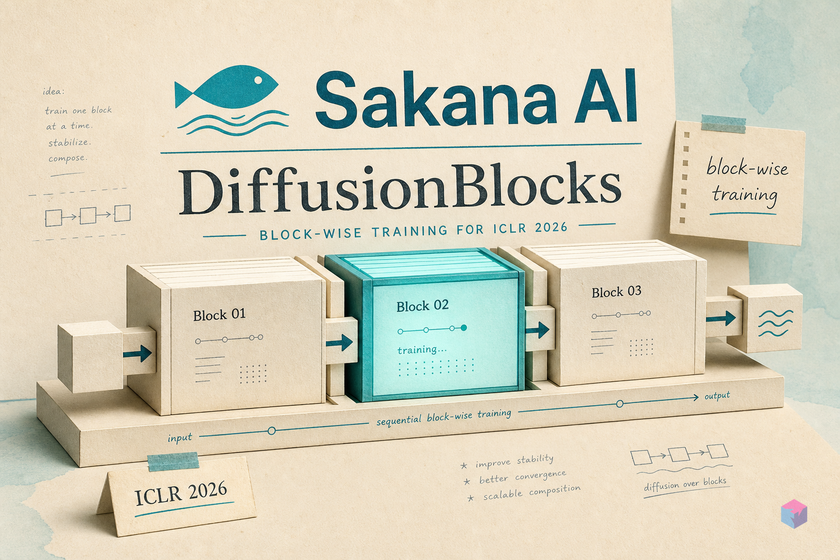
R 2026 acceptance gives DiffusionBlocks peer-reviewed standing in the training efficiency literature. Infrastructure decisions at research labs and production AI teams tend toward conservatism, and a peer-reviewed result validated across five architecture-task pairs carries more weight than a preprint. Coverage from outlets including MarkTechPost reflects early practitioner interest. Expected follow-on work will examine whether the ODE framing extends to non-residual architectures and sparse mixture-of-experts (MoE) models, where skip connection structure is absent or more complex.
| Memory Optimization | Memory Category Targeted | Compatible with DiffusionBlocks? | Notes |
|---|---|---|---|
| DiffusionBlocks | Activation memory (B× reduction) | — | Requires AdaLN conditioning and residual architecture |
| Gradient Checkpointing | Activation memory (via recomputation) | Orthogonal | Same memory category; overlapping savings, not conflicting |
| ZeRO Stage 1–3 (DeepSpeed) | Optimizer states, gradients, parameters | Yes — additive | Different memory category; theoretically composable |
| Tensor Parallelism | Parameter + activation sharding across devices | Yes | Operates at different granularity; no known conflicts |
| Pipeline Parallelism | Layer distribution across devices | Requires care | Block boundaries should align with pipeline stage boundaries |
| CPU Activation Offloading | Activation memory on GPU | Orthogonal | Both reduce peak activation memory; diminishing returns if stacked |
DiffusionBlocks is orthogonal to ZeRO sharding and tensor parallelism because it targets a different memory category from each. ZeRO stages 1–3 reduce optimizer states, gradients, and parameters across data-parallel ranks. Tensor parallelism shards weight matrices across devices. DiffusionBlocks reduces per-step activation memory by running only one block per iteration. Combining all three is theoretically additive — each addresses a distinct component of the total memory budget. The paper treats them as orthogonal but does not test combined configurations directly.
"If local score-matching objectives can match global backpropagation across classification, generation, and language modeling architectures, the design space for memory-efficient training is substantially wider than the field has assumed." — Makoto Shing, Masanori Koyama, Takuya Akiba (source: Sakana AI, DiffusionBlocks)
The most immediate application is teams running depth-heavy residual transformers or image diffusion models where activation memory is the binding constraint at scale. If activations are not the binding constraint — for example, when optimizer states for a large model consume most of device memory — DiffusionBlocks alone will not resolve the configuration. Memory profiling to identify which component is limiting should precede any adoption decision.
The broader signal is architectural. The residual-to-diffusion correspondence is a precise mathematical result: if it extends to other architecture families — and the ODE perspective is general enough that extensions are plausible — the design space for locally trainable deep networks is wider than the field has assumed. The Forward-Forward Algorithm pointed in this direction without theoretical grounding; DiffusionBlocks provides the derivation that makes the approach principled. Whether that derivation generalizes to MoE layers, state-space models, or architectures not yet designed is the central open question for follow-on work.
Frequently Asked Questions
How much GPU memory does DiffusionBlocks actually save?
DiffusionBlocks reduces activation memory from O(L) — proportional to full network depth L — to O(L/B), where B is the number of training blocks. At B=4, this is a 4× reduction in activation memory per training step. The key constraint is that optimizer states (Adam's first and second moment estimates) and parameter memory are unaffected. Total peak memory savings depend on the fraction of peak memory attributable to activations for a specific architecture and batch size. Activation-bound configurations — wide, deep transformers at large batch sizes — approach the theoretical B× maximum. Parameter-bound configurations see proportionally smaller total savings.
Does training one block at a time always converge to the same quality as end-to-end?
In most reported benchmarks, yes — and for DiT image generation on CIFAR-10 (FID 30.59 vs. 32.84 E2E) and ImageNet 256 (FID 9.00 vs. 9.01), and for autoregressive language modeling on OpenWebText (MAUVE 0.71 vs. 0.50), DiffusionBlocks outperforms end-to-end backprop. The exception is ViT classification on CIFAR-100, where DiffusionBlocks achieves 59.30% versus 60.25% for E2E — a gap of 0.95 percentage points. Quality sensitivity increases with larger B values; optimal B is task- and architecture-specific and requires ablation. There is no guarantee that very high B values maintain parity with E2E, and the paper treats optimal B selection as an empirical question.
Which architectures can use DiffusionBlocks today?
Any architecture built on residual connections: ResNets, Vision Transformers (ViT), Diffusion Transformers (DiT), masked diffusion language models, and autoregressive transformers with standard residual connections. The theoretical derivation depends on skip connections implementing Euler steps of a continuous-time ODE — that structural property is what enables the diffusion analogy and the block-wise score-matching objectives. Non-residual architectures — pure attention without skip connections, Mamba-style state-space models, other recurrence structures — are outside the current theoretical scope and would require extending or adapting the framework before DiffusionBlocks applies.
What is equi-probability partitioning and why does it matter?
Equi-probability partitioning assigns each block a noise-level range such that each block handles 1/B of the total probability mass under the log-normal noise distribution, rather than 1/B of the raw noise interval. In a log-normal distribution, probability mass concentrates at intermediate noise levels, where score estimation is hardest. Uniform interval splitting under-allocates block capacity to those challenging levels. Equi-probability partitioning gives each block an equal share of the probability-weighted training signal — concentrating more absolute noise range on the mid-range where it matters most. The practical effect is a more uniform distribution of training difficulty across all B blocks, improving overall training signal quality.
Can DiffusionBlocks be combined with gradient checkpointing or ZeRO?
Theoretically yes — they target different memory categories and are designed to be orthogonal. DiffusionBlocks reduces activation memory by running only one block per step. ZeRO (stages 1–3) reduces optimizer states, gradients, and parameters across data-parallel ranks. Gradient checkpointing trades compute for activation memory by recomputing activations during the backward pass rather than storing them. The paper treats these as orthogonal but does not test combined configurations directly. Teams planning to stack techniques should verify empirically that interactions are well-behaved for their specific architecture and batch configuration before assuming additive savings.
What DiffusionBlocks Changes for Training Infrastructure
DiffusionBlocks closes a theoretical gap that has existed in block-wise training research for years. The residual-to-diffusion correspondence is a precise mathematical result, not a heuristic, and the empirical coverage across five architecture-task pairs is broad enough to be credible across domains. For teams where activation memory is the binding constraint on a depth-heavy residual model, DiffusionBlocks is a concrete alternative to gradient checkpointing that carries less compute overhead — at the cost of AdaLN conditioning modification and ablation work to identify the right B.
The constraints are real and should shape adoption decisions. Optimizer state memory is unchanged, so the full savings only materialize when activations are genuinely the bottleneck. Checkpoint compatibility requires architectural modification before training begins, with no described fine-tuning path from existing checkpoints. The ViT classification gap, while small, may matter at production scale. Non-residual architectures are out of scope. The current reference implementation primarily covers the CIFAR-100 ViT example; teams needing to reproduce DiT or language modeling results from the paper should verify implementation availability before planning a timeline.
The larger significance is architectural. Local score-matching objectives matching global backpropagation across classification, generation, and language modeling is a result the training efficiency field will build on. Whether the ODE framing generalizes beyond residual architectures — to MoE layers, state-space models, or architectures yet to be designed — is the question to watch. DiffusionBlocks provides the principled starting point for that investigation.
Last updated: 2026-05-30. Based on the DiffusionBlocks paper at arXiv:2506.14202 (accepted ICLR 2026) and the official Sakana AI repository, reviewed as of late May 2026.