-limiting, and request inspection for AI API calls. It does not function as a credential vault or real-time human-approval interrupt. If your need is controlling LLM API costs and monitoring usage at scale, it solves a different problem from Overslash entirely.
Solo.io's agentgateway (Linux Foundation) and Palo Alto's unified AI gateway operate at the network and orchestration layer — traffic policies, routing, and model access controls. Neither implements per-identity blast-radius chains or call-level credential injection as an owned primitive. Both are worth evaluating for enterprise governance at the network layer; neither replaces what Overslash does at the per-call credential layer.
Decision framework for practitioners:
- Okta/Auth0 shop, existing identity flows, no multi-agent hierarchy needed → Auth0 AI is the lower-friction path.
- Entire stack on AWS, Bedrock-native agents, no self-hosting requirement → Bedrock AgentCore has the tighter integration.
- Need LLM API cost control and usage observability → Cloudflare AI Gateway; this is a different problem from credential management.
- Multi-agent pipelines on Claude Code, Cursor, or shell-based toolchains; credentials must never reach agent context; need per-call blast-radius and synchronous human approval; prefer or require self-hosted → Overslash targets this combination directly.
Frequently Asked Questions
Is Overslash open source?
The gateway core is released under the Elastic License 2.0 — source-available but not OSI-certified open source. Under ELv2, you can inspect the source, self-host the gateway for your own automations without restriction, and contribute to the codebase. What ELv2 restricts is commercial redistribution: offering Overslash as a managed hosted service to external customers is not permitted under ELv2 without a separate commercial license. The services registry — the connector definitions for GitHub, Slack, AWS, and the other integrations — is MIT-licensed and fully open; anyone can add or modify connector definitions without ELv2 restrictions.
Can Overslash run fully self-hosted with zero cloud dependency?
Yes. The self-hosted tier is entirely free, includes all features, and uses a local encrypted vault. No cloud component is required at any point. The no-telemetry, no-phone-home policy is enforced at the binary level — not as an opt-out setting but as the compiled default, with no outbound telemetry path present in the binary. All three access surfaces (REST API, CLI binary, and MCP server) work against a self-hosted instance. Credentials stay on your own infrastructure and are never transmitted to Overslash's cloud services.
What does an automation actually receive when it calls Overslash with a handle?
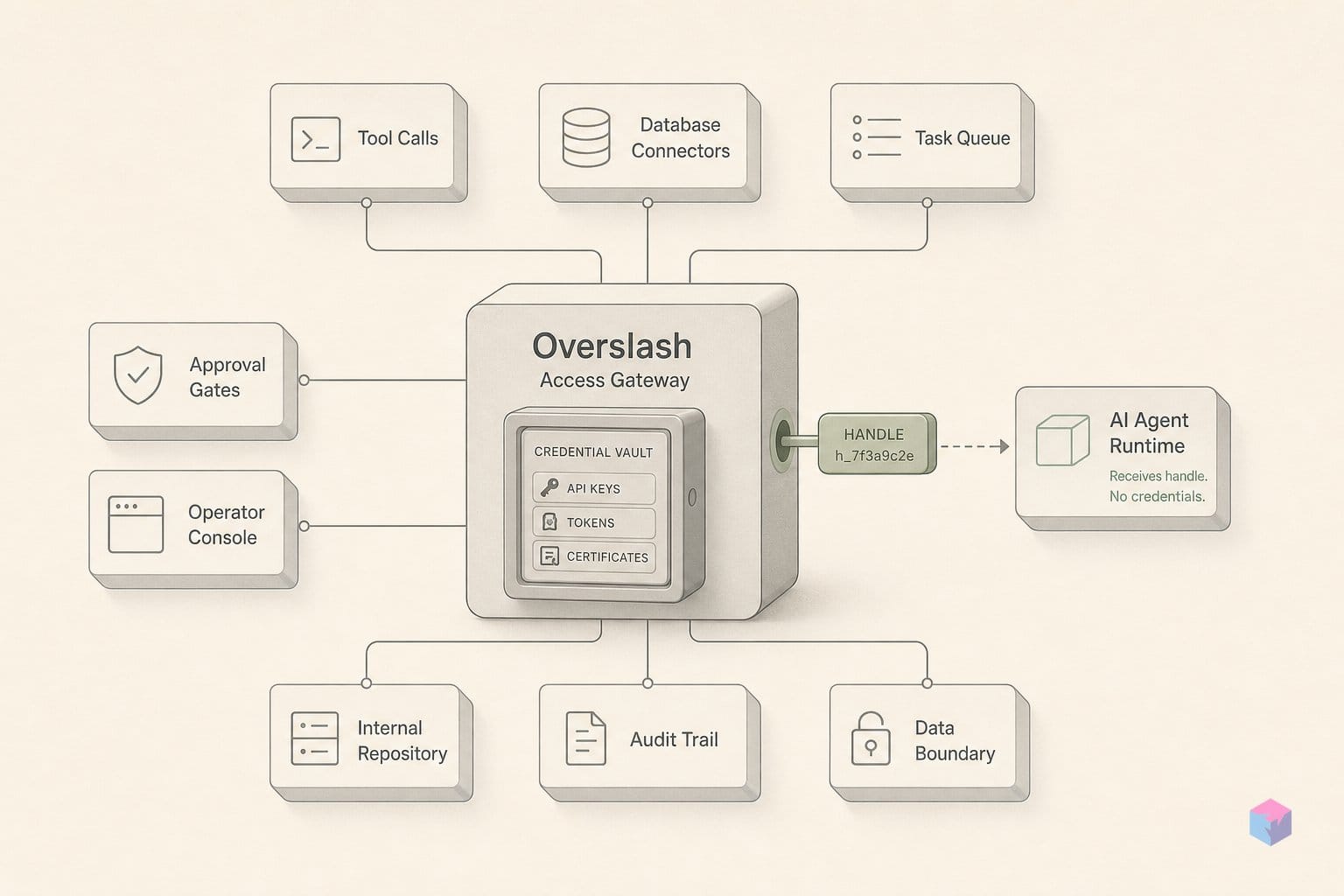
The automation sends a handle string — for example, gh-token-prod — to the Overslash gateway. The gateway resolves the handle to an encrypted vault entry, injects the actual credential value into the outbound HTTP request (in the appropriate header or request body for the target service), forwards the request to that service, and returns only the downstream service response to the calling automation. The automation receives the service response. It never receives the resolved credential value; that value is discarded from the gateway's memory after the outbound request is forwarded.
What happens when a sub-automation tries to exceed its blast radius?
The call is blocked immediately at the gateway and escalated up the identity chain to a human reviewer. The reviewer sees full chain context: which agent made the request, which service it attempted to reach, and the escalation path. The reviewer must choose one of three options: deny (request fails, event is permanently logged with full context), approve-once (request succeeds for this call only, no rule is stored — the next identical request will escalate again), or approve-and-remember at a chosen scope level (a new gateway-layer rule is created, the request succeeds, and future identical requests within that scope will not escalate). The calling agent blocks synchronously until the human responds.
How is this different from rotating IAM roles or short-lived tokens?
IAM roles and short-lived tokens reduce exposure duration but leave the structural problem intact: the automation still holds the credential in its process memory for the full session lifetime. No per-call human approval interrupt exists, there is no blast-radius enforcement across a multi-agent chain, and there is no cross-service audit trail at the individual call level. A short-lived token can still be logged, cached, or exfiltrated during its validity window. Overslash enforces per-call scoping regardless of session state — the credential is never present in the agent's context or process memory at all, making session duration irrelevant to the exposure model.
Where Overslash fits in your stack
Overslash is a narrow product with a clear surface area: it solves the credential-in-context problem for agentic systems, enforces blast-radius containment per identity, and provides a synchronous human-approval interrupt. For developers building multi-agent pipelines with Claude Code, Cursor, or shell-based toolchains — where the agent's conversation history is a real attack surface, not a theoretical one — those are the right three problems to address at the infrastructure layer rather than in prompts or environment configs that can be modified, leaked, or bypassed independently.
The caveats deserve plain statement. Overslash is in public beta as of mid-2026, with explicit documentation that APIs and behaviors are subject to change without notice. No independent third-party security audit is publicly available. No latency benchmarks from external sources exist. The team, funding status, and production SLA timeline are not disclosed in public materials. The Rust implementation and binary-enforced no-telemetry policy are meaningful architectural commitments — but they are not substitutes for a completed security audit when evaluating this for production workloads that touch payment processors or sensitive data stores.
The evaluation path is low-friction: the self-hosted tier requires no account and exposes all three access surfaces immediately. A practical starting point is wiring the CLI or MCP server into a non-production pipeline against the GitHub or Slack connector, verifying that the blast-radius model behaves as documented for your agent topology, and then assessing the Team cloud tier if your organization needs shared connection management and structured audit export. Given the documented pressure on authentication models to adapt for AI agent actors, a purpose-built per-call credential gateway is worth validating against your actual pipeline before defaulting to session-scoped patterns that were designed for human users.
Last updated: 2026-05-31. Based on Overslash public beta documentation at overslash.com as of May 2026. Features, pricing, and connector availability are subject to change ahead of general availability.